
Self-evolving Research AI
Research becomes
emergence.
You came to investigate. Ideas came with it.
A knowledge graph connects what you know.
When public data and internal documents become one map,
white spaces and unexpected angles reveal themselves.
- ✓Autonomous exploration of internal and external data
- ✓Automatic white-space detection
- ✓Discover ideas from accumulated, comprehensive knowledge
Values
What changes when an agent has memory
01 — TOTAL RECALL
Remember everything. Recall from any angle.
Total-recall knowledge graph
Keyword, similarity, opposition, connection paths — explore memory from every angle and bridge distant knowledge into new combinations.
02 — EVOLVE
The more you talk, the smarter it gets.
Self-evolving agent
Every conversation builds memory, skills are acquired naturally, and investigations run autonomously. A research partner that gets smarter the more you use it.
03 — SWARM
Multiple agents debate each other.
Multi-agent swarm
Specialized agents research and debate in parallel, reaching conclusions no single agent could.
How to Use
Chat like you talk. Research becomes emergence.
You don't change how you think. The graph changes what you find.
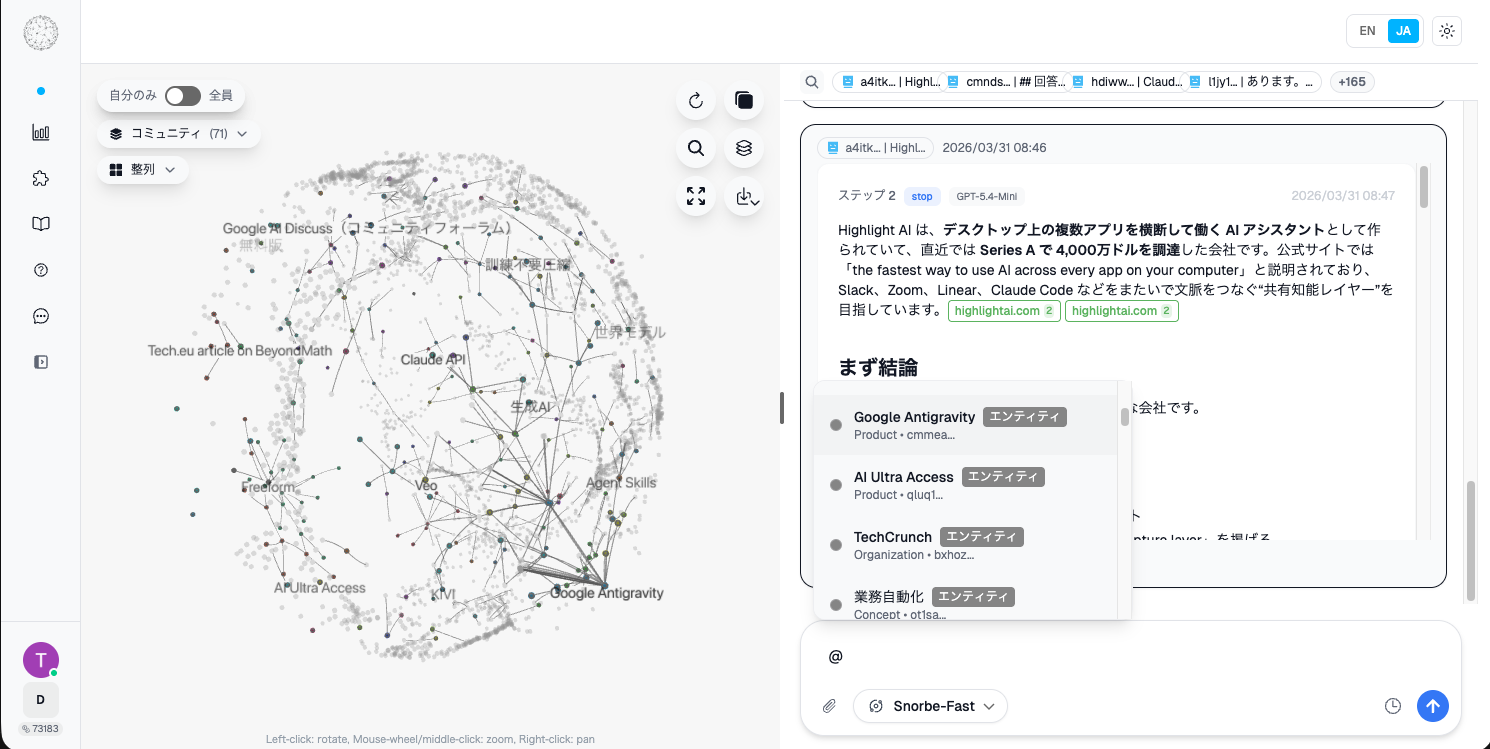
STEP 1
Just chat. Research begins.
Start research the way you'd start a conversation. Attach PDFs, spreadsheets, or images directly. Use @mentions to reference past research or entities and dig deeper. Switch between OpenAI, Anthropic, Google, and xAI models. Plan Mode lets you review and adjust the research plan before running.
Chat interface
Start research the way you talk
File attachment
Drop in PDFs, Excel, PPT, or images
@mention
Reference past research and entities
Multi-model
OpenAI / Anthropic / Google / xAI
Paste URLs directly
Reference web pages or documents in chat
Stop & Resume
Pause and change direction anytime
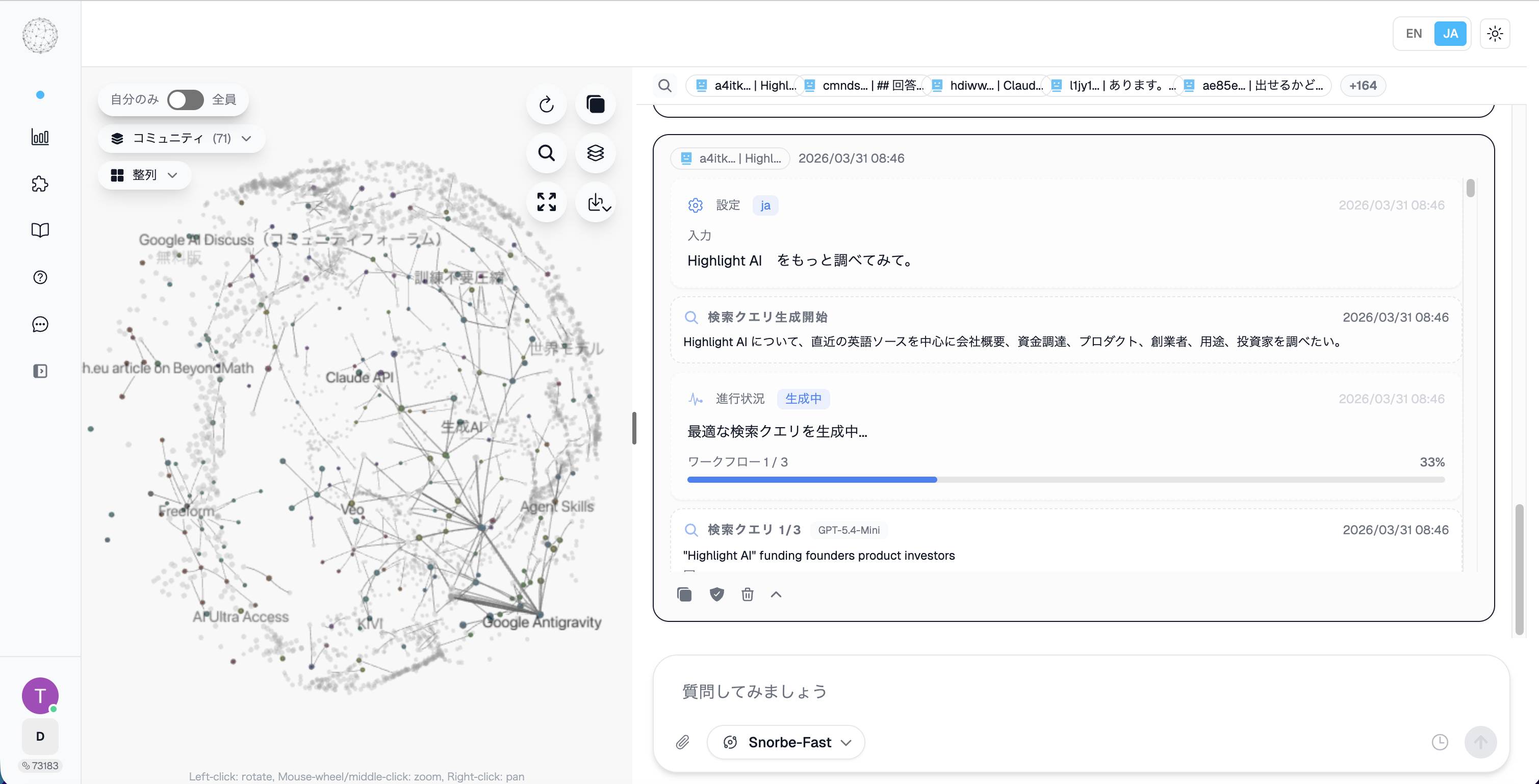
STEP 2
AI picks the right tools and skills, researches autonomously.
AI automatically routes to the best tools — web search, X, specialized databases, or live browsing — and researches across all of them. Plan Mode generates a structured plan for review before execution. Build your own custom skills in code.
Web search
Auto-collect papers, news, and patents
X search
Capture real-time discussions and trends
Browsing
Auto-navigate web pages for information
Specialized DBs
arXiv / PubMed / Semantic Scholar / e-Stat
Custom skills
Build your own research skills in code
Plan Mode
AI drafts a plan — review, confirm, then run
Per-agent skill config
Assign specific skills to role-based agents
Document processing
Read, create, and edit PDF / DOCX / XLSX / PPTX
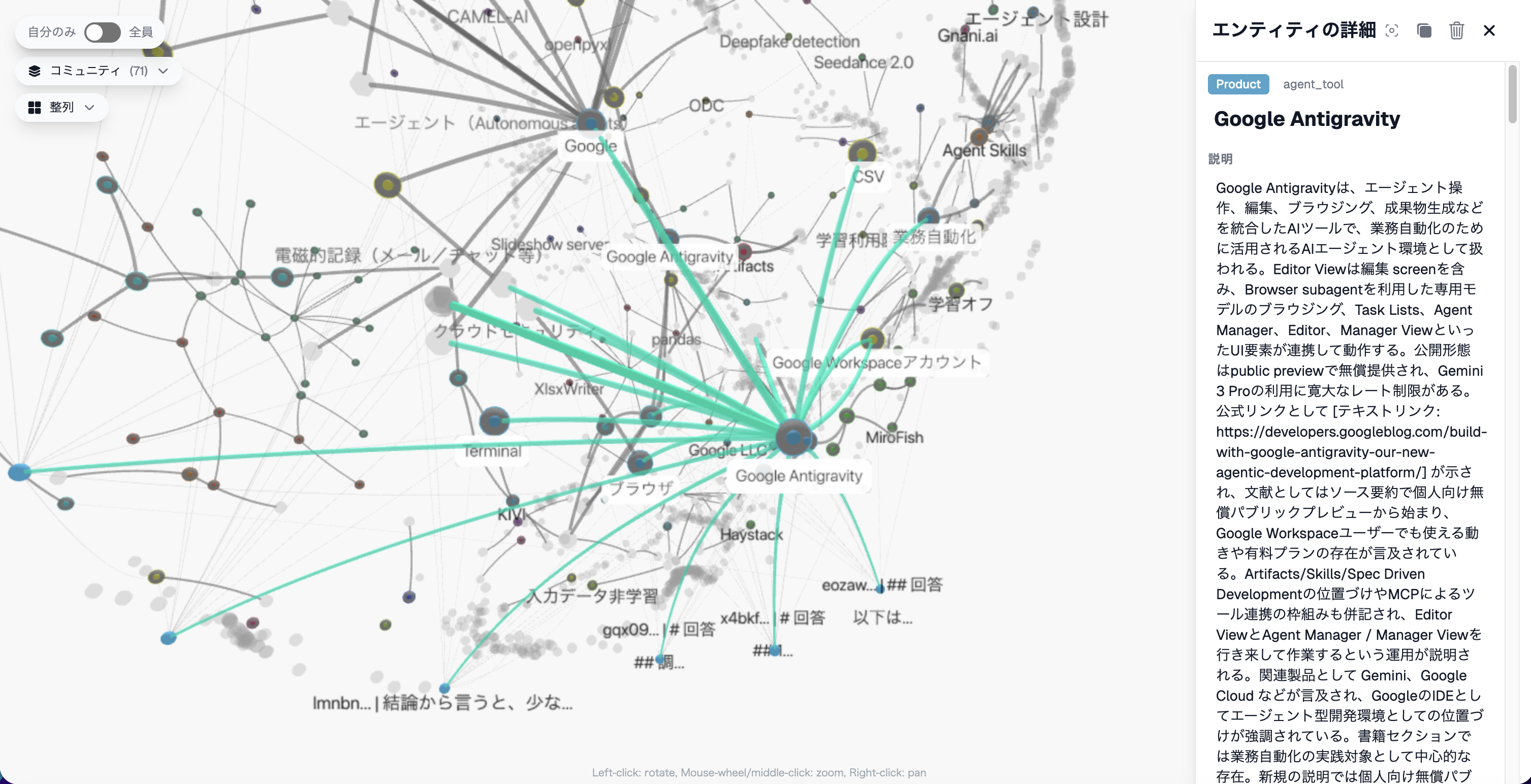
The moment of emergence
The graph shows you what you don't know.
As research accumulates in the knowledge graph, unexplored white spaces surface automatically. Community clustering organizes related findings, and AI proposes the next research targets autonomously. When unexpected connections appear — that is the moment of emergence.
Knowledge graph
Accumulate and visualize as nodes and links
White-space detection
Auto-highlight unexplored areas
Community clustering
Automatically group related information
Next-step proposals
AI identifies unexplored areas and suggests next moves
Similar entity discovery
Auto-detect nodes with similar characteristics
Fact-check
Trace back to source and verify instantly
Opposition Recall
Auto-explore counterarguments to your hypothesis
Connection Recall
Discover indirect relationship paths via beam search
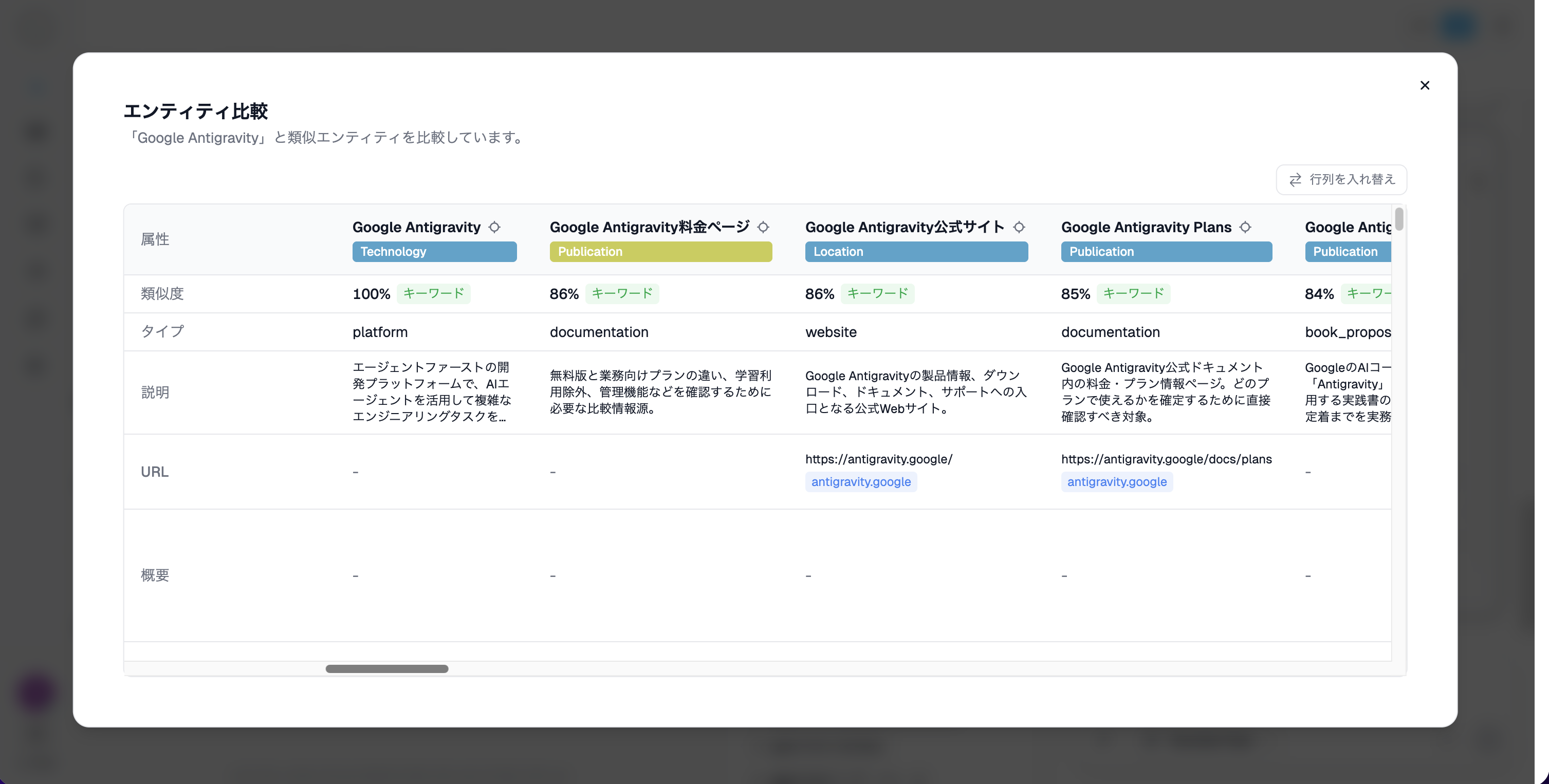
STEP 4
Memory becomes ideas.
Use Recall to chain through the graph from a keyword, discovering ideas from past research. Automatically generate viewpoint matrices and structured reports, share knowledge with your team, and schedule automated research with email notifications on completion.
Recall exploration
Chain through the graph from a keyword
Viewpoint matrix
Auto-generate comparison tables, export CSV/Excel
Structured report
Markdown / PDF output
Team sharing
Merge team knowledge into the same graph
Scheduled automation
Daily/weekly auto-research with email alerts
Self-host
Deploy in your own environment with Docker
Agent Memory
Retains context across research sessions
Custom Views (Visual Map)
Classify and survey entities along two spatial axes
Use Cases
Where emergence happens
Snorbe is industry-agnostic. Anywhere deep research matters, it works.
The white space nobody noticed becomes your next venture.
Build a technology map and you'll always find areas nobody has entered yet. Snorbe visualizes those white spaces on a graph and generates evidence-backed business hypotheses in minutes.
Flow
Features in action

The next experiment arrives before you finish reading papers.
Even after reading 100 papers, you still can't tell which angle remains unverified. Snorbe integrates papers, patents, and internal reports into one graph and surfaces unexplored viewpoints automatically.
Flow
Features in action
Walk in fully prepared. Deliver proposals that land.
Automatically collect customer websites, news, and social signals into a graph to surface interests and pain points. Discover accounts with similar needs, and go from research to share-ready proposal in one flow.
Flow
Features in action

Solutions
Go deeper with industry-specific pages
Dedicated pages with research templates and viewpoint axes for chemical, materials, semiconductor, and pharma.
Solutions
Industry & domain solutions
Dedicated pages with research templates and viewpoint axes for each industry — the AI builds the actual queries.
Patent & IP research
Specialized for chemical, materials, semiconductor, and pharma IP. Prior art search, design-around, and white space exploration in a day.
Advertising & copywriting
Briefing design, brand-guide-compliant copy generation, and cross-reference visual scouting — all in a single workflow.
Pharma & bio research
A dedicated page in preparation: cross-reference PubMed, trial data, and papers to surface competitive pipelines and target white space.
Semiconductor & electronics market research
An industry template in preparation: patent trends in process, materials, and equipment combined with supply chain analysis.
Quick Compare
How Snorbe stands apart, at a glance
A quick side-by-side with representative AI research agents. Full comparison in the dedicated article.
| Criterion | OursSnorbe | Overseas Deep Research | JP lightweight AI search | JP patent-specialized AI |
|---|---|---|---|---|
| Integration scope | Papers + patents + news + internal docs in one graph | Web-focused one-shot search | Web-focused personal search | Patent DB only |
| White-space discovery | Auto-detected via knowledge graph | Not supported | Not supported | Not supported |
| Industry-specific BPO | Chemical / IP / new venture in production | Not supported | Not supported | IP only |
| Japanese coverage | Japanese-first (multilingual cross-search) | Limited | Strong | Full |
| Pricing transparency | Public | Public | Public | Mostly undisclosed |
Plans
Plans
Experience emergence, or run it inside your walls with your own data.
Early access (free)
Try the core Snorbe emergence experience and co-build with feedback.
- ✓Chat-based research with multi-model support
- ✓Autonomous research across web, X, specialized DBs, and browsing
- ✓Plan Mode and custom skill support
- ✓Automatic white-space detection and graph visualization
- ✓Viewpoint matrix extraction + CSV/Excel export
- ✓Structured report generation
- ✓Scheduled automation (daily/weekly) with email alerts
- ✓Dedicated Slack and weekly feedback loop
Self-hosted PoC / Enterprise
For teams needing to handle confidential data internally with onboarding support.
- ✓Guided Docker Compose deployment
- ✓Workspace/RBAC setup and audit-log design
- ✓Custom research templates
- ✓PoC white-space analysis bundled with reports
- ✓Enterprise security review support
Q&A
Frequently asked questions
QCan we ingest internal data as well?
Can we ingest internal data as well?
Yes. Upload internal PDFs/Excels/PowerPoints, combine them with public data (news, papers, patents, government reports), and build a knowledge graph. You can detect white space and create viewpoint matrices that include internal evidence.
QHow accurate is white-space detection?
How accurate is white-space detection?
White spaces are visualized on the graph after each research run. Every suggestion includes citation links so you can inspect the supporting nodes directly on the graph.
QWhat self-hosting support do you provide?
What self-hosting support do you provide?
In the PoC/Enterprise plan we help live with Docker Compose setup, env configuration, RDB/pgvector initialization, and access design.
We also provide security checklists and audit-log designs, and customize graph schemas or viewpoint templates as needed.
QWhere is the data stored?
Where is the data stored?
The cloud version stores data in PostgreSQL + pgvector. For self-hosting, all data stays in your own PostgreSQL instance.
Let's join
"Research becomes emergence."
Experience it.
You came to investigate. Ideas came with it. That's Snorbe.